Kustomer
/Head of Product Design
/2022–2025
/Team of 6
Putting AI everywhere: from mandate to market
Led design for Kustomer’s AI copilot, taking an executive “put AI everywhere” mandate to a product agents use all day.
Agent efficiency
+65%
Copilot-assisted agents worked up to 65% more efficiently
#1 client
Re-signed
That efficiency is why our largest enterprise account renewed: a seven-figure deal
AI sales
First profitable quarter
The renewal and new AI deals made Q3 2025 the first profitable quarter
Series raise
$30M
The financial evidence behind the raise
Product NPS 3.4 → 25 during the rollout
Context
The executive mandate was simple: “Put AI Everywhere.” The reality was a market moving fast, tech debt, and a customer service industry where trust is the product.
The customer service AI market was $37 billion with 20% annual growth. Competitors were racing to AI-first solutions. The industry trajectory was clear: 20–30% agent reduction and 80% of routine issues handled by AI within two years.
Kustomer had competitive pressure and tech debt. After the Meta divestiture, the design system was neglected and engineers were pulling outdated patterns off the shelf.
What I owned
The mandate from leadership was to put AI into every surface of the product. I owned how that shipped, in a category where trust is the product.
But the spec-it, design-it, hand-it-off process couldn’t move fast enough. The old workflow assumed building was the bottleneck. Now the bottleneck was knowing what to build and shipping before the market moved past us.
What I did
Sold AI internally and restructured design operations around an AI Design Stack. Worked directly with founding engineers to build and design on the fly, with no handoffs and no spec documents, while keeping GTM and pricing teams in the loop on what was shipping and why.
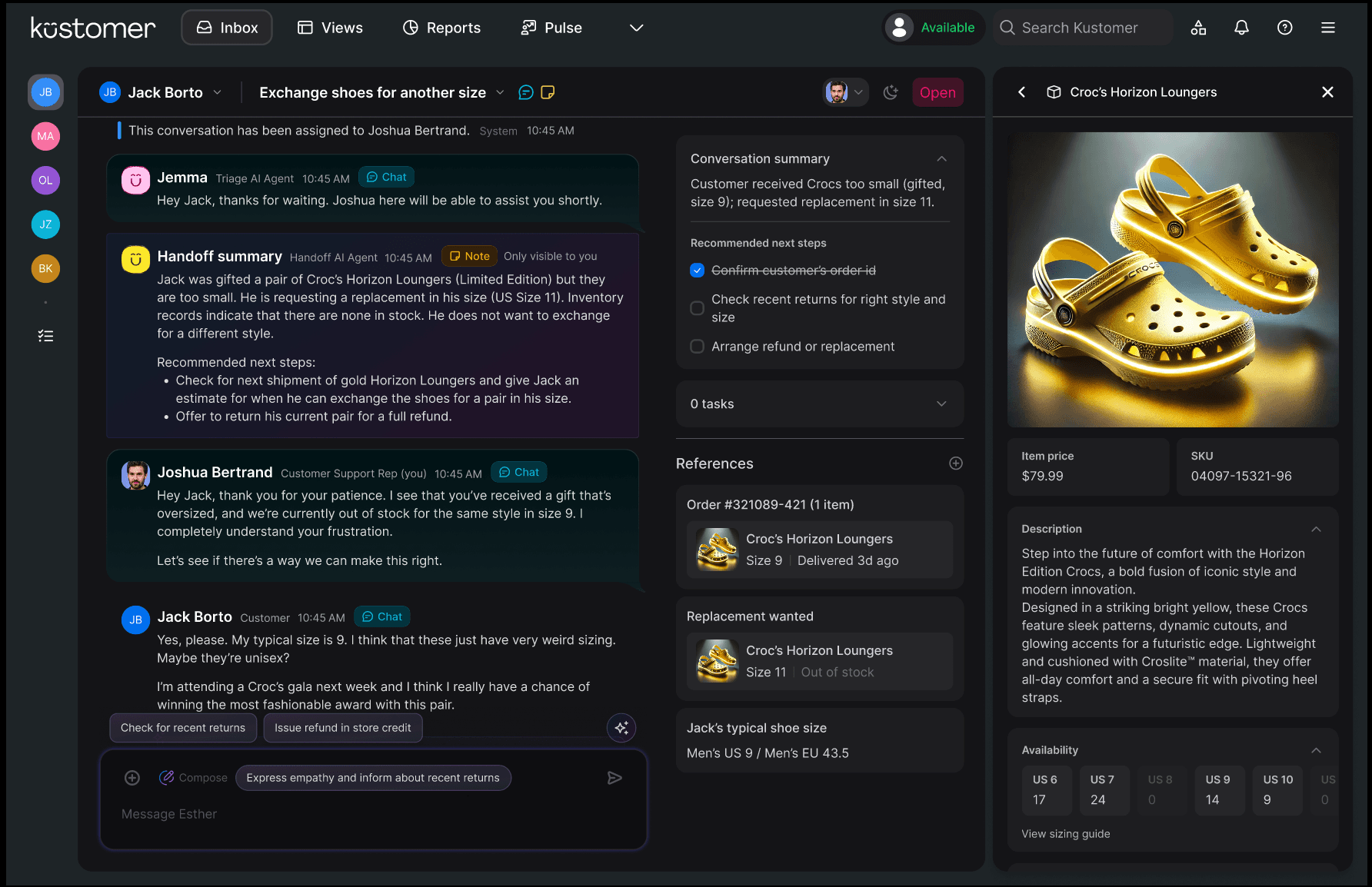
Pitched to get the design system funded and staffed as foundational infrastructure. Cleaned up the existing system, then built an entirely new section to support AI-native interaction patterns: copilot surfaces, conversation summaries, trust indicators, and progressive disclosure for AI confidence levels. The system became the bridge between engineering speed and design quality.
Proved design could ship at engineering speed. Took reporting, the #1 reason we lost deals and stuck in the backlog for months, and rebuilt it with our most senior designer in 2 weeks instead of quarters, using an AI-accelerated workflow (Claude for design logic, GitHub for implementation, Storybook for validation). Once engineering saw it, they stopped routing around design and started pulling it in early.
Audited the entire product, decision by decision, to determine what should be AI and what should stay a manual selection. Every choice an agent makes got a verdict: automate it, have the copilot suggest it, or leave it to the person. That audit is where the bottleneck actually moved. It told us what to build before we built anything, and it decided where the copilot went first.
Designed a “Now & Later” strategy: a V1 copilot that could go to market quickly, plus a future vision for an integrated AI solution with new workflow and programmatic features. This gave the team something to ship today and something to build toward.
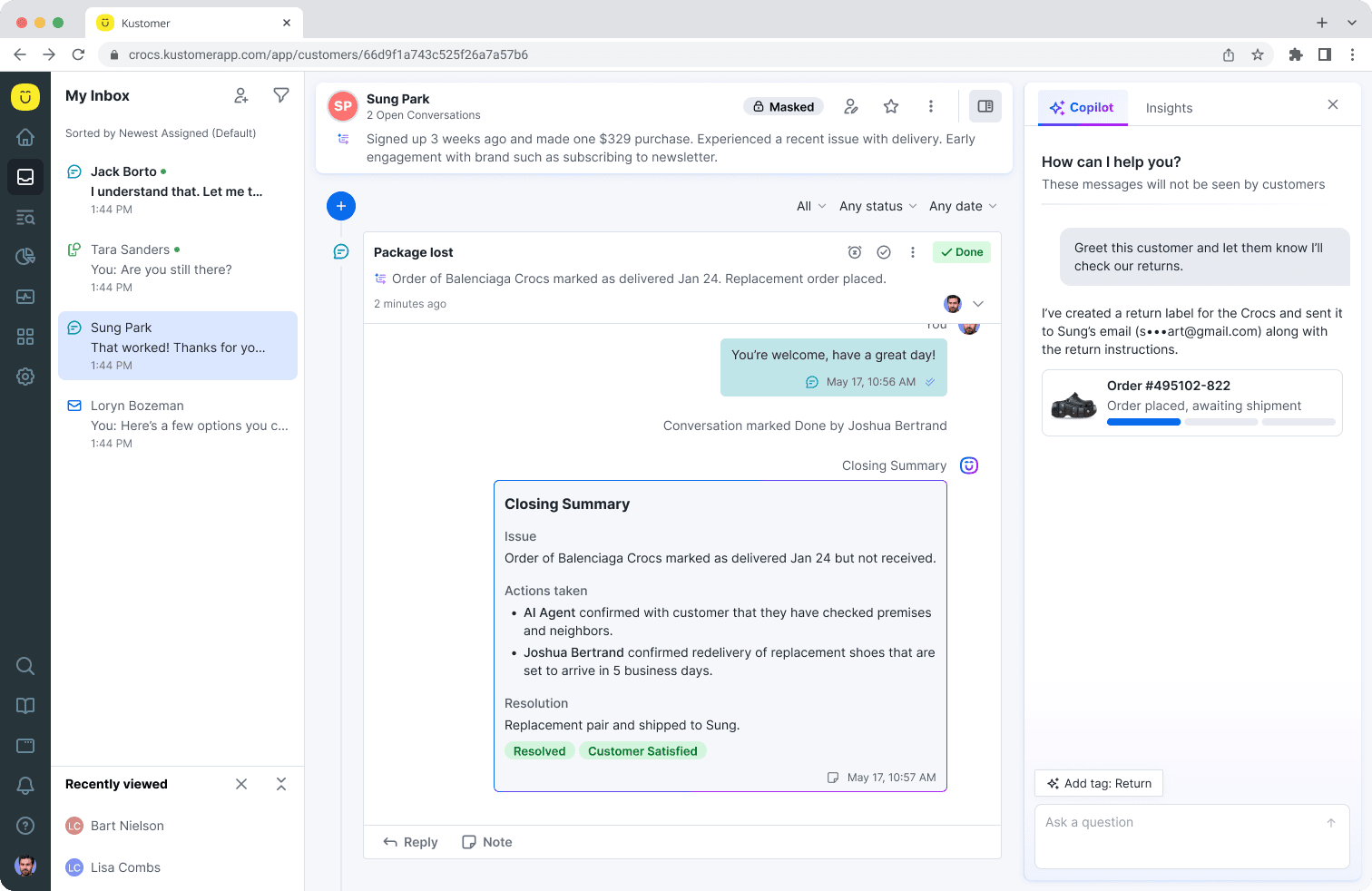
Shipped Phase One Copilot with order lookup, summarization, and message reply suggestions as multi-agent default capabilities. Advanced features let admins connect tools to specific brands, build agent teams, and customize order progress workflows.
Designed opening and closing conversation summaries so handoffs between AI and agents actually worked, a need that came straight out of user interviews. Customer service is a trust game. Every edge case and error state had to build confidence in the AI. Used the AI release as leverage to bring other timeline enhancements out of the backlog.
Trade-offs
Hard call
Had to launch without AI actions initially: the copilot could suggest but not act. Shipping a read-only V1 felt incomplete, but it let us validate trust before giving AI more power.
Sequencing
Developed Agent Studio before Agent Experience. The admin tooling shipped ahead of the agent-facing improvements. Right for the business timeline, painful for the end-user story.
Pricing
Introduced multiple SKUs due to Zuora billing complexities. Added friction to the sales process that we’d have avoided with a cleaner architecture.
Culture
Going fast in isolation had a cost. The speed was necessary, but the team paid for it in coordination that better communication rhythms would have reduced.
Timing
Should have moved design onto AI workflows earlier. Nine months before, at an offsite, the team had recognized AI was entering the space and built early designs. But we defaulted back to Figma workflows to keep up with the roadmap. The urgency of the present kept delaying the investment in the future.
Adoption gap
Not every designer adopted at the same pace. The team members who leaned in got dramatically faster. Those who didn’t fell further behind. Managing that gap required more coaching than anticipated.
“He didn’t just make things look better — he changed how the team thought about the problem.”
David Drucker, Founding Engineer, Kustomer