Words. Meaning. AI.
Everything we do with AI is words tuned for meaning. Five things I built to get more of it out of a page.
If you are interacting with AI you are probably typing into a text input box, or for those on the advanced track, using voice to talk to it. Either way we are feeding it words and tuning them until they land.
That takes structuring what's in your head clearly enough for a machine to follow. Not much different from doing it for a person.
I've always been fascinated with meaning and words. In art school I sculpted words to get more meaning out of them. Post-college I wrote a book around the concept of the Akashic records, the idea that every thought ever thought is stored in a library somewhere, readable if you learn how. I've held on to that picture: around every sentence is a crowd the page never shows you. The other views on it. The shorter version of it. The feeling under it.
Last month I wrote that words are the design: most of what a product is, is text, and the products that fail usually fail in the language first. If words carry that much, a page shouldn't just be a straight line you read top to bottom. So I built a few ways to get at what's inside them, and this article walks you through each one. Try them as you go.
Feature 1 · What do the big brains think about that?
Highlight any sentence in any article across the Ideas section that reads like a claim. On your phone, press and hold. A small chip appears, and it usually names a name: someone who sees it another way.
Tap it and three thinkers arrive on a rail that runs from builds on it at the top to pushes back at the bottom. One extends the claim further than I did. Another turns it into a different question. The last one takes the opposite view entirely, and that one opens first, because the angle furthest from mine is usually the one worth seeing. Three points on a spectrum, the same sentence seen from each.
The takes are simulated, and the panel says so. Each is built from what that thinker has actually written, not what I wish they'd say. If you want to hear them out in full, one more tap opens The Symposium, where they think it through together.
Feature 2 · Get to the point
Nothing game-changing here. I wanted to work on animations, and on making sure the meaning still lands. So: what's left when you take everything else away? Some days you have six minutes for an essay. Most days you have forty seconds.
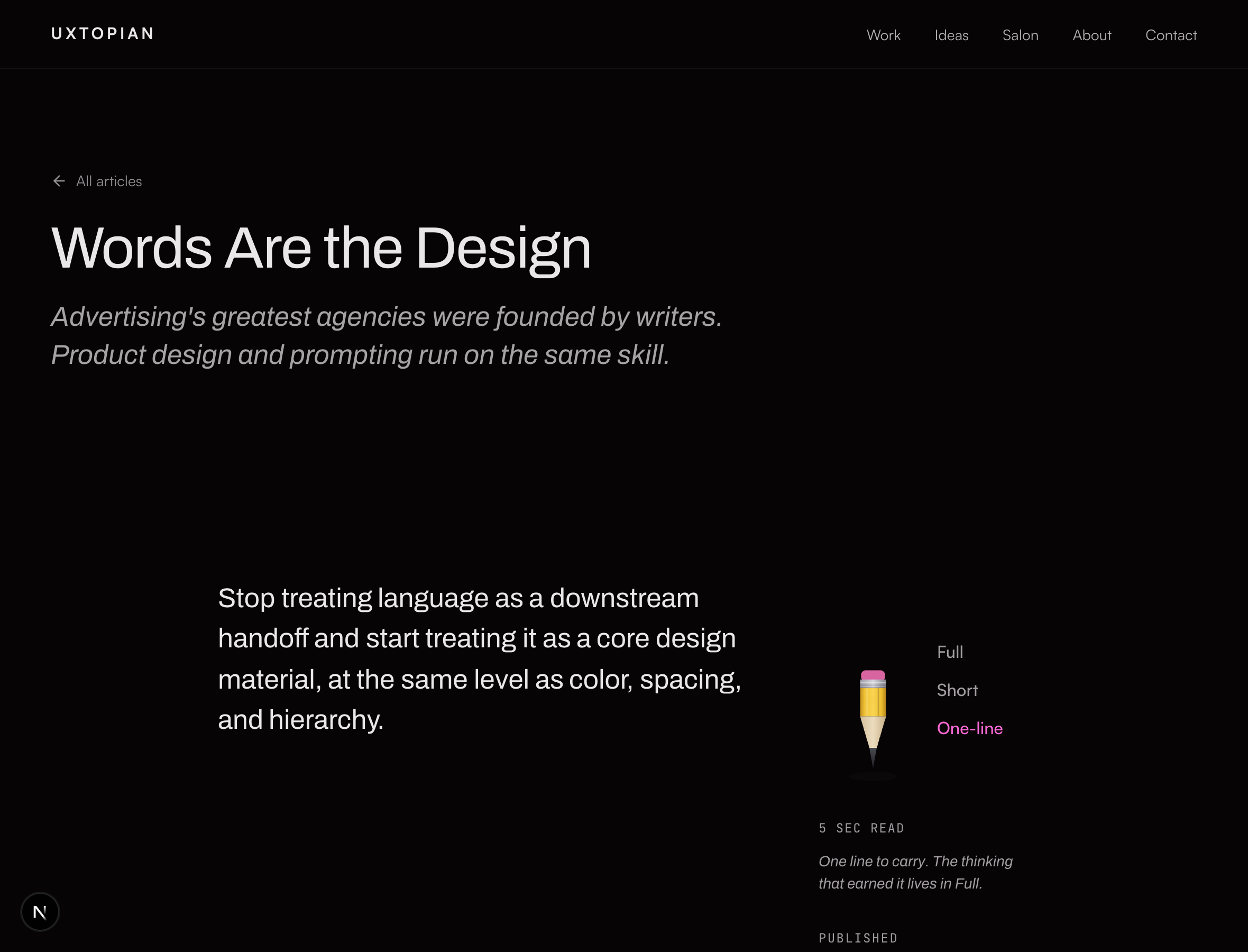
Next to every longer piece on this site sits a drawn yellow pencil with three settings: Full, Short, One-line. Pick Short and the essay drops to its spine, about forty seconds of reading. Pick One-line and you get the single sentence I'd want you to carry out the door. The pencil wears down as you go. The barrel shortens, the eraser drops, the old words scatter off the page. Sharpening, literally.
Feature 3 · From read a word to watch the word
Some words mean something by how they move. Scattered through these articles are words that behave like what they mean. A panicked word hyperventilates. A word about mistakes corrects itself mid-sentence. A word about gravity falls off its baseline. Print gives every word the same volume no matter what it says. Motion turns some of them back up.
Feature 4 · Can you back this claim up? Who would back you up?
And when you'd rather ask than read, there's a door for that. It lives on the home page, not here on the articles, and you'll want a desktop for it.
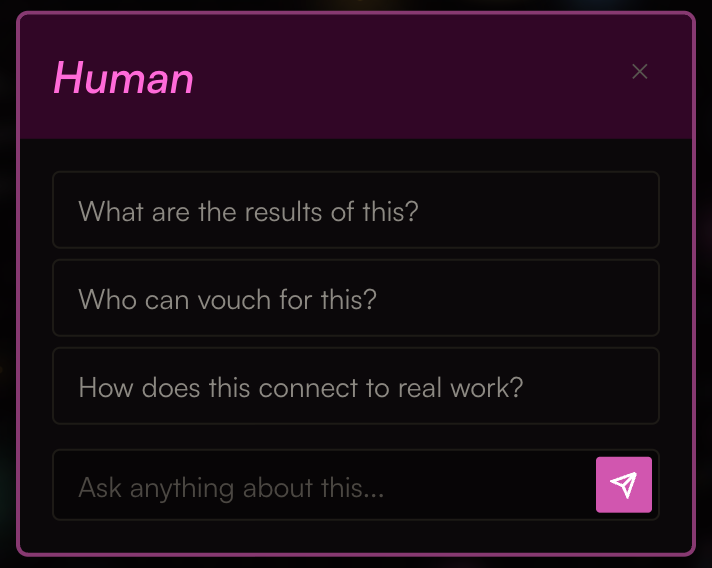
A handful of words on the homepage wear a faint dot: the ones in the headline, the claims, the numbers. Hover one and the dot turns into ask →. Click it and a small box opens. Ask whatever you want about that word or claim, the kind of thing you'd ask me across a table. The answer comes back built from the record, my work, my writing, and the people I've worked with, a few of whom show up by name to back it up. No improvising. If the record can't support an answer, I'd rather it say less.
Feature 5 · Easter eggs
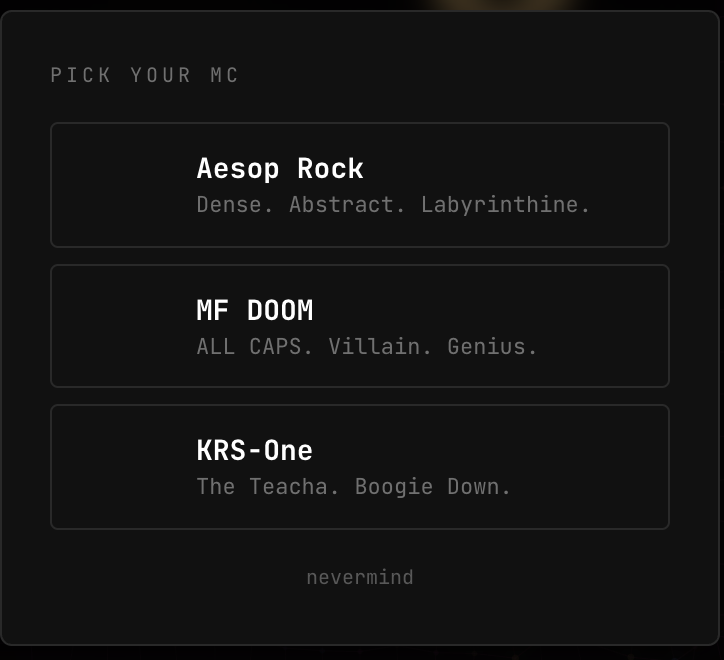
The last one I won't set up. There's a line in the footer that doesn't behave like a footer. Click it and the whole site starts talking in a different voice, someone with a lot more rhythm than me, for about a minute. That's all the hint you get. Go find it.
Why bother
None of this needed to exist. The articles worked fine as plain text.
But I spend my days telling clients that the words are the product, that an error message is design, that clarity is the thing that scales. A site that only states its point of view is a brochure.
AI made these possible; no person could hold that many perspectives on call, or rewrite a whole page in sixty seconds. But the model doesn't choose the angle. I decide which sentence is worth opening, and what an essay keeps when it loses everything else. That part was always the job.
The page shows you one point of view. The others were always standing around it.
A lot of people are trying to work out the next way to talk to a machine. The text box we all started in is one answer, and a good one, but it won't be the last. Voice is already here. Whatever comes after it, nobody's drawn yet.
So I use my own site to try. These five are small experiments in how a person and a model might talk: something you can interrupt, argue with, shrink to a line, or just ask. The back-and-forth chat is one shape for that conversation. I wanted to know what the other shapes feel like. If the text box was only the first idea, what would you build?
Highlight any sentence and three thinkers weigh in.
Ian Alexander
Design leader & design engineer — writing on leadership, AI product strategy, and building teams that ship.