Mailchimp
/Sr. Director of Design
/2018–2019
/Team of 8
When email became a platform
Led product design for the innovation track as Mailchimp grew from an email tool into a marketing platform, closing the gap between the new brand and the product people actually used.
Conversion touch-points
Strengthened
Upgrade and onboarding flows redesigned by the team, per Mailchimp’s Director of Brand Design
Paid subscriptions
+90% YoY
New paid subscriptions, with design’s upgrade and onboarding changes in the path
Context
Market forces were pushing Mailchimp from email into an all-in-one marketing platform. The rebrand was the signal to the market, but the product experience didn’t match the ambition. A competitive audit against Airtable, Shopify, and Squarespace exposed the gap: jarring color shifts between pages, inconsistent typography, a dashboard that competed with itself for attention, and a product that lacked the structural “container” competitors used to create coherence.
Brand design and product design operated in silos. Marketing shipped beautiful campaigns. Product shipped functional screens. The experience didn’t feel like one thing. It felt like six things stitched together.
What I owned
Nobody was responsible for the seam between brand and product. That seam was my job.
The teams shared the same goals. The process was the problem. Design decisions were made in private and revealed in reviews, which meant feedback came too late to be useful and cross-team influence was accidental. Fixing the experience meant fixing the process that produced it.
What I did
Made the work public. Posted wireframes and in-progress designs in the hallways and common spaces so people would collide with them. When people could see the work forming, they pulled themselves in. Brand designers gave product feedback. Product designers absorbed brand language. By the time the formal review happened, the right people had already shaped the decisions. The review ratified them.
Turned opinions into evidence. Ran a competitive UX audit against Airtable, Shopify, and Squarespace: Mailchimp’s dashboard had 6 CTAs where competitors had 4, the product lacked a visual container, and the most important action on the page had the least visual weight. That audit became the design brief the team rallied around, and the basis for the experience and pricing strategy of the platform expansion.
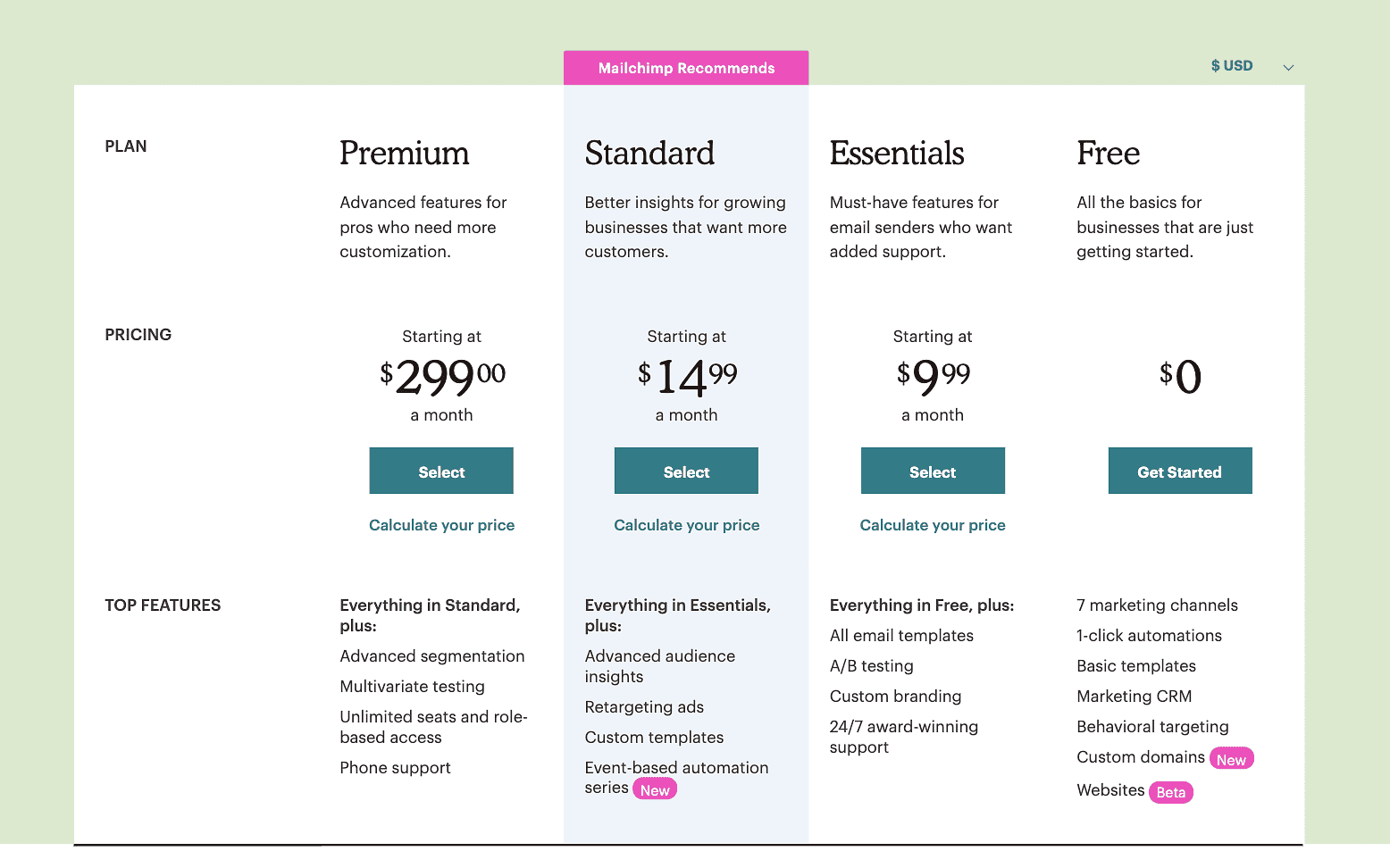
Moved upgrades into the moment of need. Paid features lived on a pricing page, far from the moment someone wanted them. Made each one an upgrade in place: add a custom domain, remove Mailchimp branding, then publish. Pricing shipped as product moments instead of a page.
Shipped Social Start. New users who lived on social media had to begin in email, a product they hadn’t come for. Social Start let them begin from social instead, the first product expression of the “all-in-one” positioning.
Moved Content Strategy under Design. What Mailchimp said and what the product did were decided by different teams. Putting them in one function connected messaging to experience at the structural level.
Trade-offs
Scope vs. depth
The platform expansion touched everything: pricing, onboarding, feature discovery, brand expression. Chose breadth over depth in the first pass to establish the experience framework. Some individual surfaces shipped with less refinement than they deserved.
Working in public
Hallway wireframes and open process created healthy collisions, but also noise. Not every passerby’s opinion was useful, and managing the signal-to-noise ratio took more facilitation than expected.
Org design
Moving Content Strategy under Design was the right structural call, but it created friction with the marketing team who’d owned that function. The transition required more relationship management than the org chart change implied.
“Ian is an effective and strategic design leader who prioritizes people and business outcomes. He is able to quickly understand complex user ecosystems, competitively interpret opportunities, and bring others along with crafted storytelling.”
Brandy Porter, Director of Brand Design, Mailchimp