PrivacyPal
/Design & Strategy Advisor
/2026
The right product with the wrong story
Repositioned an engineering-led AI privacy startup from one more governance tool to the product that stops data leaks before they reach the model, then launched it live.
Positioning
Audit → Prevention
From one more after-the-fact governance tool to stopping leaks before data reaches the model
Product
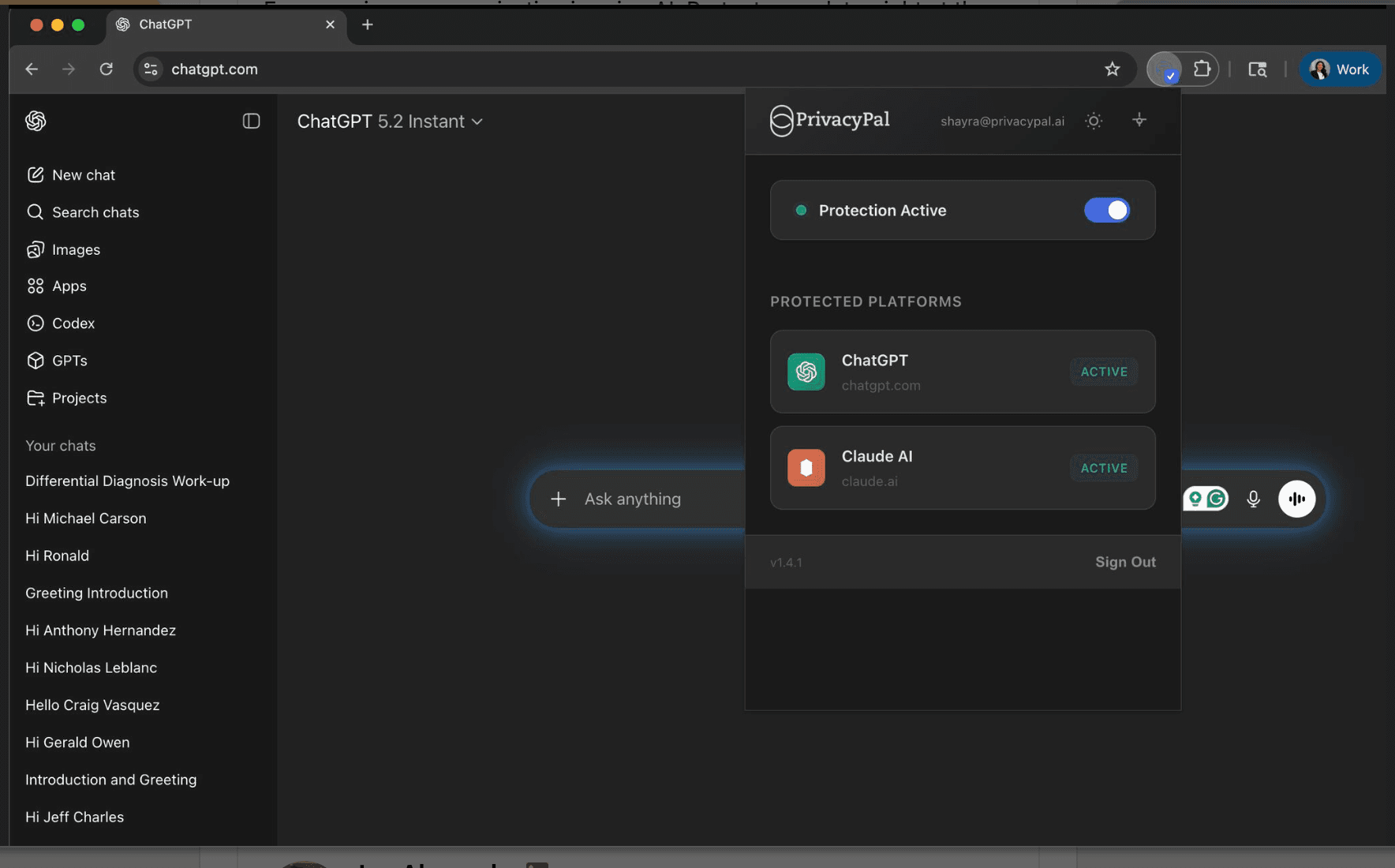
Protection visible
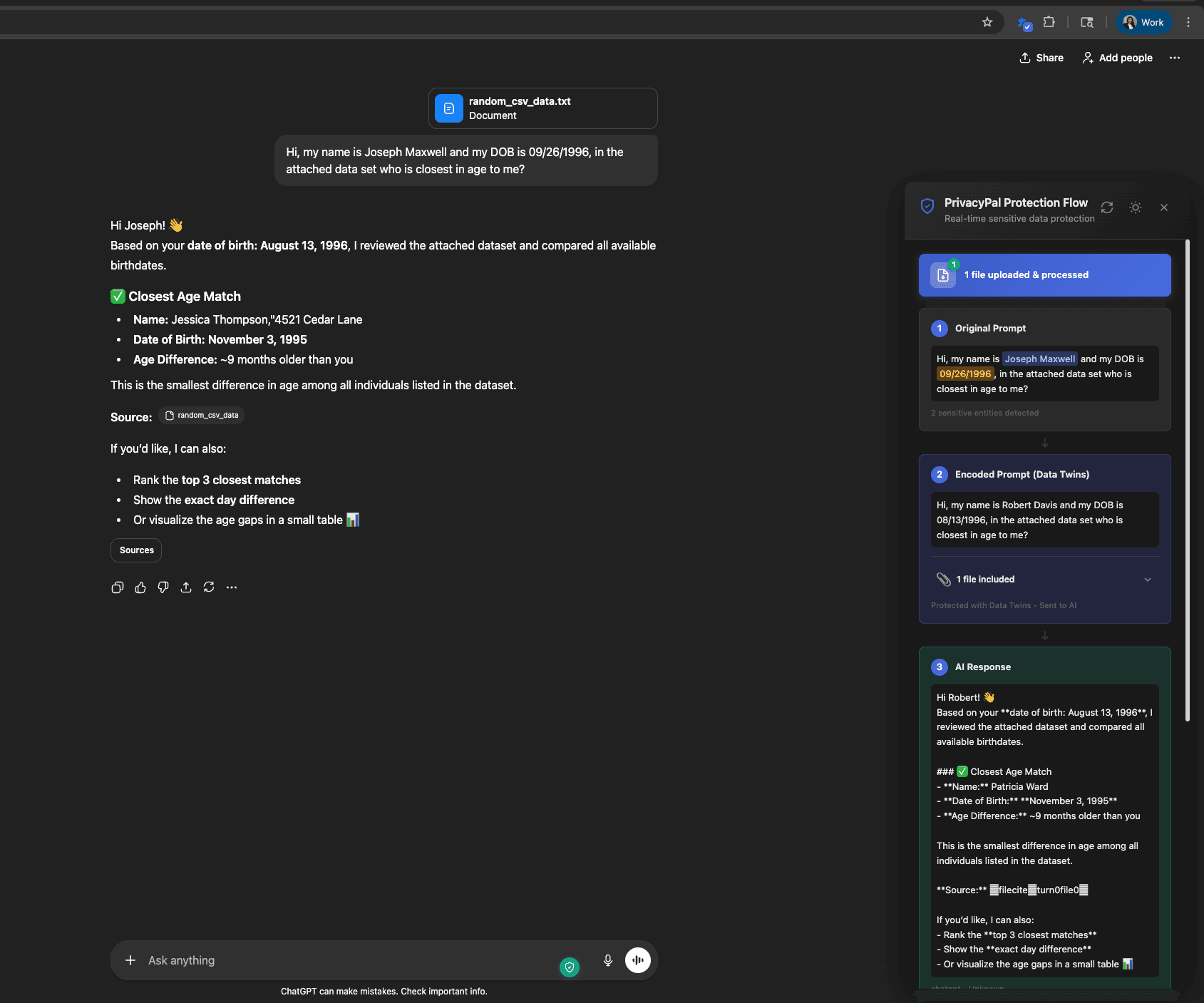
Real-time data swaps shown in the product; admin panel and onboarding updated for launch
Launch
Live demo
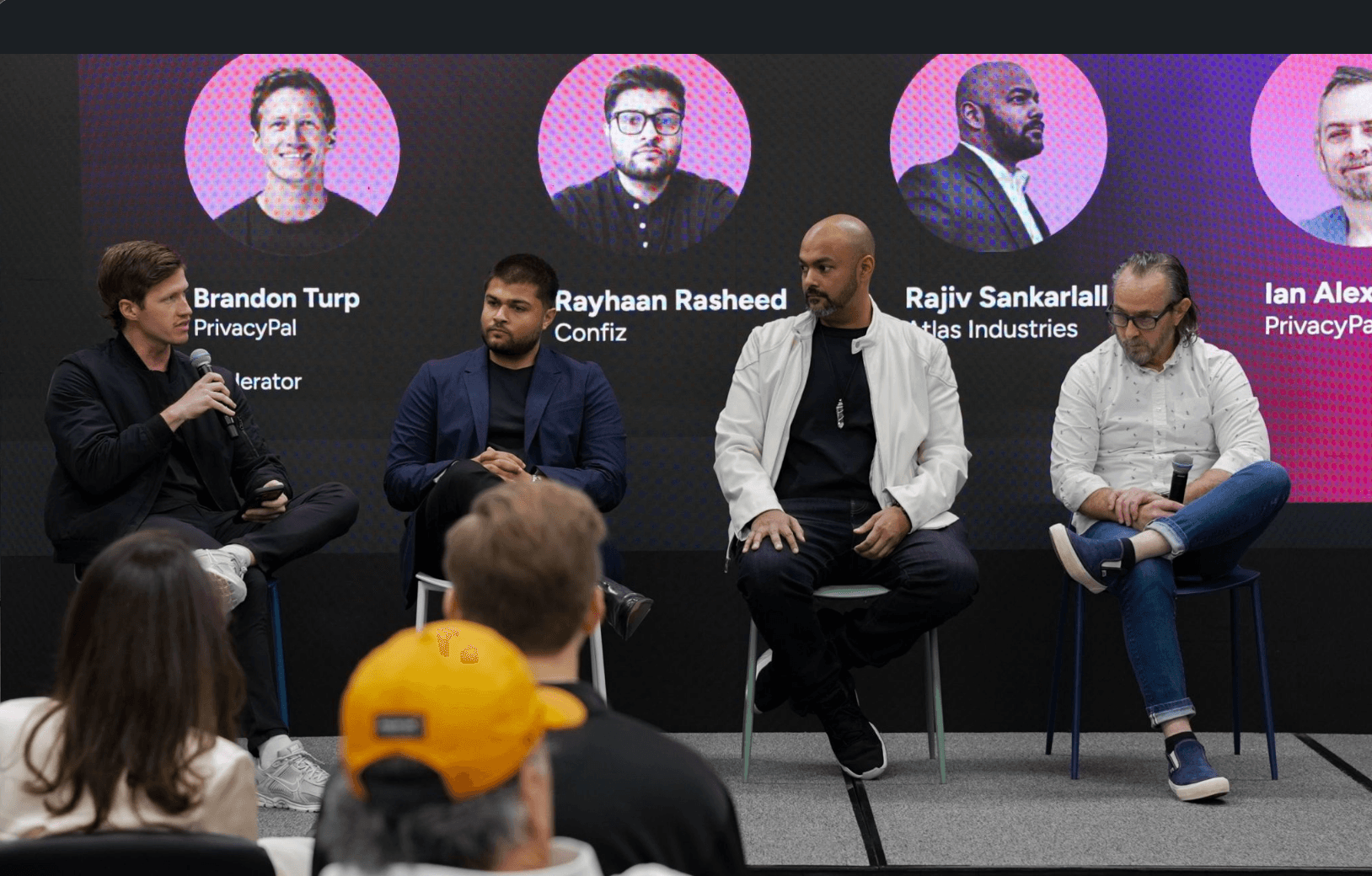
Privacy Twins demoed to founders and operators at The LAB Miami, January 2026
Early stage: no revenue or conversion numbers yet.
Context
Every day, employees paste customer names, financial data, health records, and proprietary code into ChatGPT, Claude, Gemini, and other AI tools. That data becomes part of the model. The regulatory landscape (HIPAA, COPPA, GDPR, CCPA) makes this a compliance crisis, but the regulations weren’t written for the way people actually use AI. Most enterprise solutions audit exposure after the fact. Nobody had a clean answer for preventing it at the point of input.
Nobody doing this is careless. They’re under pressure. Companies push AI adoption without training people on what they can and can’t share. Workers are trying to keep up with the speed expectations their organizations set. PrivacyPal’s core technology, Privacy Twins, swaps real data for synthetic equivalents in real time. It solved the technical problem elegantly. But this was a small, engineering-led team. The product worked. The story around it didn’t.
What I owned
I advised the founders on design and strategy: who PrivacyPal was for, what it promised, how the product made that promise visible, and how it went to market.
What I did
Narrowed who it was for. “Everyone needs privacy” meant no one in particular. Focused the ICP on teams under compliance pressure who already use AI every day, and defined the competitive frame: governance tools tell you what went wrong; PrivacyPal stops it from happening.
Rebuilt the promise. Pitched as a security tool, the product sounded like friction. Worked with the founders on a promise-and-product framework around “Use your favorite AI, privately,” recasting PrivacyPal as the thing that makes AI adoption safe enough to speed up.
Made the protection visible. Privacy Twins worked invisibly, so people couldn’t see what it was doing for them. Directed product updates that show data being swapped in real time, and updated the admin panel and onboarding to shorten time-to-value.
Launched it live. Organized the launch at The LAB Miami in Wynwood and spoke on its panel, with a live Privacy Twins demo for founders, operators, and builders. Positioned PrivacyPal as an enabler: the thing that lets teams use AI faster because the risk is removed at the source.
Trade-offs
Early-stage honesty
No clean metrics by the time the engagement ended. The company was still collecting user feedback and working toward its first revenue, so the repositioning and launch are the result, not the numbers they were meant to drive.
Narrowed aggressively
Chose to focus the ICP tightly rather than chase the broader enterprise market. Left larger segments on the table to build momentum with a specific audience first. Right for the stage; means the big numbers come later.
“Ian ensures the product is not only compliant and secure but also intuitive, credible, and built for long-term trust.”
Jason Melo, Co-Founder, PrivacyPal · launch panel introduction, January 2026